
The Luma range from Swedish fire safety brand HOUSEGARD lets you create a complete wireless home fire safety system with interconnected devices that warn of danger throughout the house and send alarms and notifications straight to your smartphone.
Why choose interconnected alarms?
A traditional smoke alarm is a standalone device that sounds an alarm in the room where it is installed. But will you hear a smoke alarm going off in the basement, garage or at the other end of the house while you are in your bedroom at night? Especially if there are several closed doors between the rooms?
HOUSEGARD Luma solves this problem by connecting fire safety devices in different rooms of your home into a single wireless network. If one of the connected alarms detects a hazard, the other alarm devices connected to the system also sound an alarm.
For example, if a fire starts in the garage at night and the heat alarm there detects a dangerous rise in temperature, the alarm signal also reaches the devices near the bedrooms.
You also receive alarm notifications on your smartphone, so you can respond quickly even when you are away and your children, elderly parents or pets are at home.
How does the HOUSEGARD Luma system work?
Luma devices communicate wirelessly with one another on the 868 MHz radio frequency. Up to 40 devices can be connected to a single network, allowing you to create a suitable fire safety solution for a small flat, a multi-storey house or a larger property.
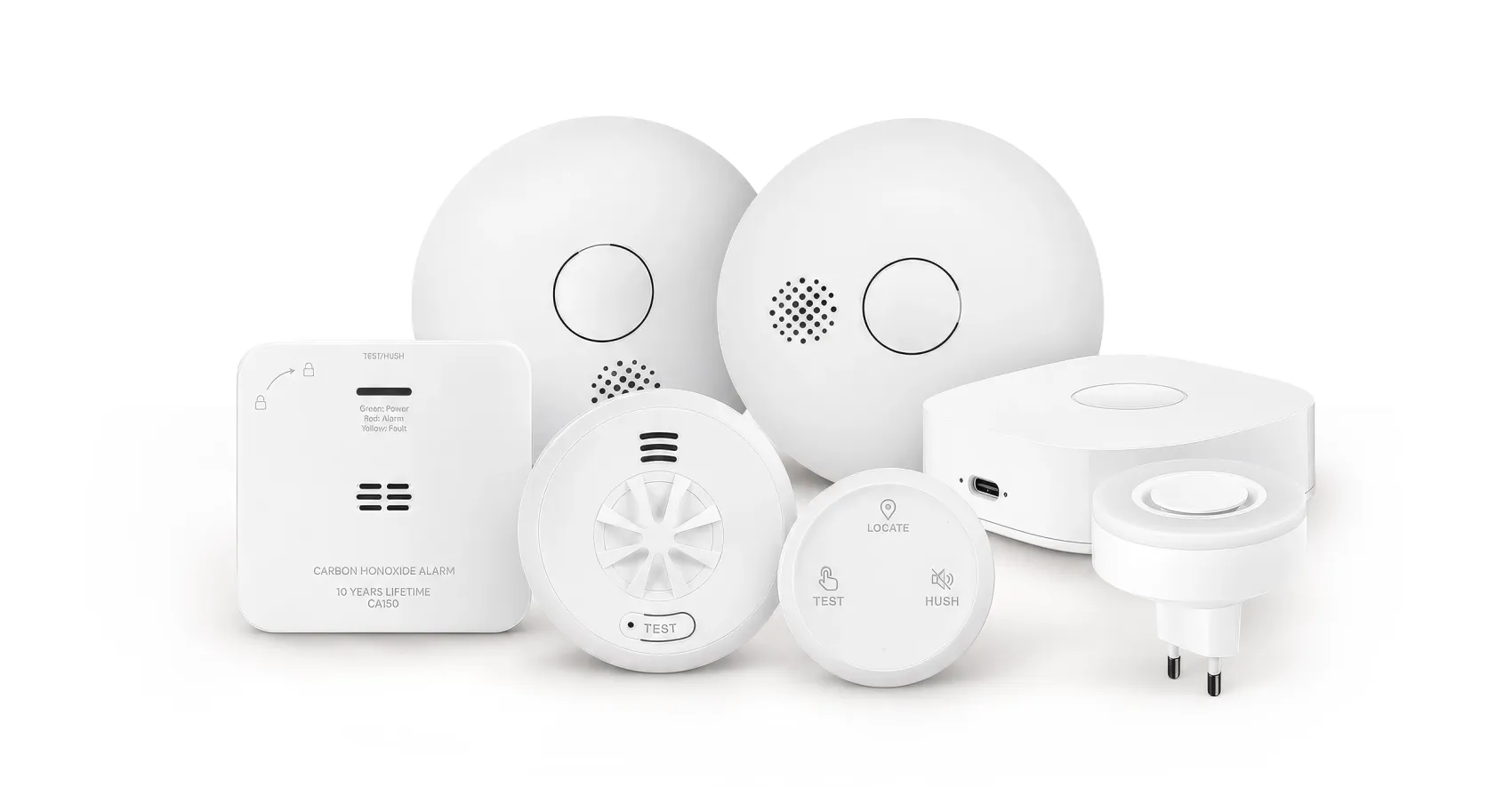
The Luma fire safety system includes:
- Luma Hub for connecting to a smartphone.
- optical smoke alarms (white and black);
- carbon monoxide alarm;
- heat alarm;
- remote control;
- smart siren;
The Luma range also includes a water leak detector that works as a standalone WiFi smart device.
Connecting the alarms to one another is easy. Choose one smoke alarm as the master alarm and connect the other devices to it according to the user manual.
Luma smoke alarms have a radio communication range of up to 100 metres in an unobstructed environment. The actual communication range depends on the building's structure, wall materials, number of storeys and other obstacles. If needed, the Luma smart siren helps extend the system's radio communication range.
Would you like alarm notifications on your smartphone?
The alarms communicate with one another by radio frequency and do not need a home WiFi network, internet connection or separate central unit to do so. Even during an internet outage, the network of connected battery-powered alarms continues to work, and a hazard detected by one alarm triggers an alarm throughout the connected system.
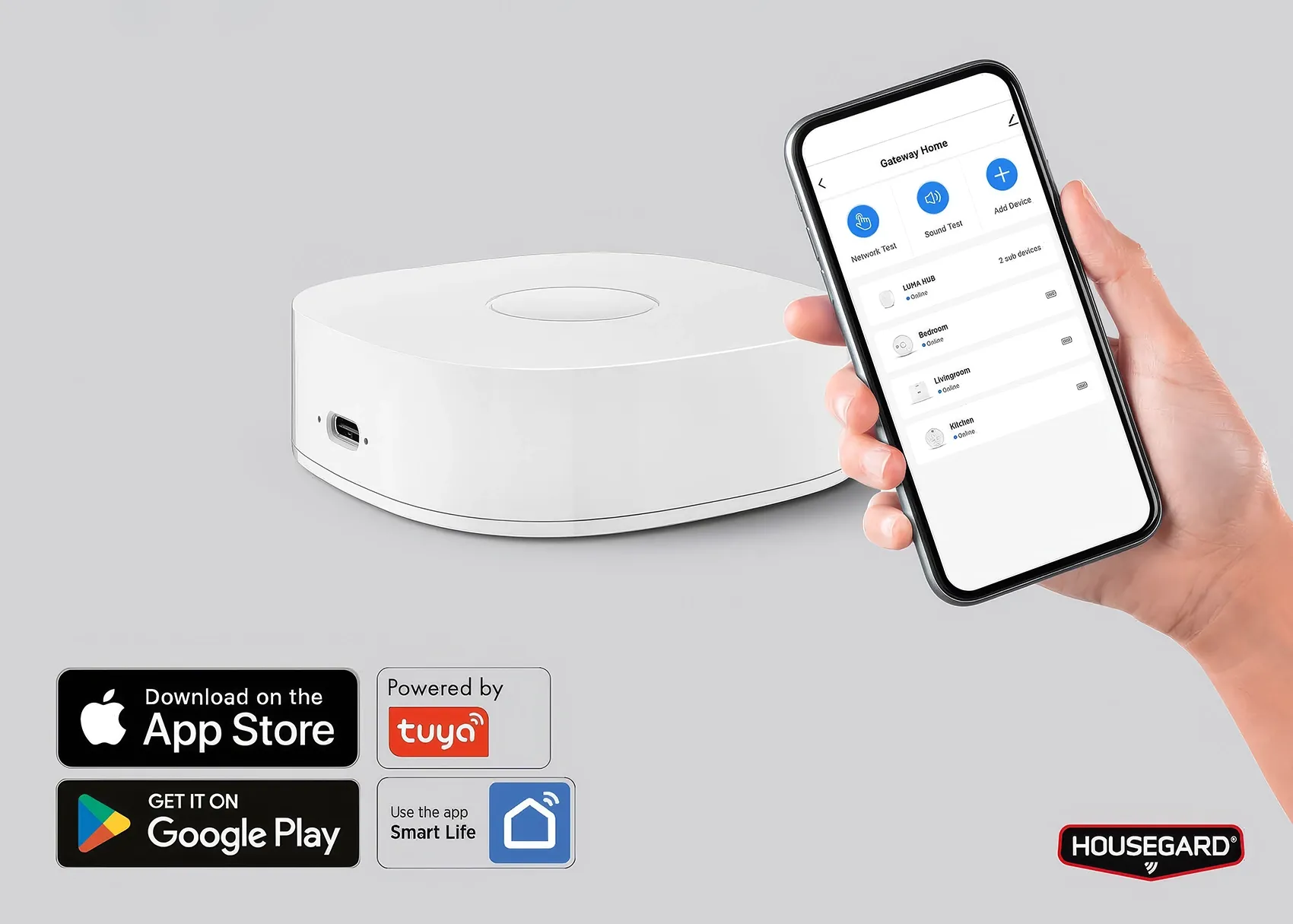
However, to receive alarm notifications on your smartphone (SmartLife app), monitor the status of your devices or test them remotely, a HOUSEGARD Luma Hub needs to be added to the system.
The Hub is therefore not required for the fire safety system to work, but adds extra smart features.
How can you tell which alarm was triggered first?
When all the alarms in your home sound at once, it is important to know which device triggered the alarm.
This is easy to identify in the Luma system:
- a red LED flashes rapidly on the smoke alarm that triggered the alarm;
- a green LED flashes on the other connected smoke alarms.
You can also use the Luma remote control or the Smart Life app connected to the Hub to identify the source of the alarm.
HOUSEGARD Luma Hub – your home’s fire safety on your smartphone
What happens if a fire breaks out at home while you are at work, travelling or at your holiday home?
A conventional fire safety system sounds an alarm at home, but if you are away, you may not know anything about it. The HOUSEGARD Luma Hub lets you receive information from the system on your smartphone too.
The Hub connects the Luma fire safety system to your home Wi-Fi network and lets you monitor the devices via the Smart Life app.
What can you do in the Smart Life app?
- Receive alarm notifications even when you are away from home.
- Identify the detector that triggered the alarm.
- Test connected devices.
- Silence confirmed false alarms.
- Monitor detector battery levels.
- Receive low-battery notifications.
- Receive notifications when a smoke alarm is removed from its mounting plate and refitted.
- View the air temperature around the smoke alarm when it sounds an alarm.
- View the carbon monoxide concentration reported by the carbon monoxide alarm.
- Manage the smart siren’s additional functions.
This overview of fire safety at home is especially valuable for people who are often away from home, travel frequently or also want to monitor fire safety in the homes of elderly loved ones.
Watch the video: connecting LUMA detectors to the HUB
What happens if the internet connection is lost?
Radio communication between Luma detectors does not depend on the internet. Connected battery-powered detectors continue to operate normally even during an internet outage.
During an outage, however, smartphone notifications and remote control functions that require an internet connection are unavailable.
The Hub therefore provides an additional way to monitor fire safety in your home, rather than being a requirement for the detectors to work together.
HOUSEGARD Luma remote control – all essential functions within reach
Testing smoke alarms regularly is important, but let’s be honest – if it means getting the ladder out every time, this essential check can easily be skipped.
The HOUSEGARD Luma remote control makes everyday use of interconnected alarms much more convenient.
The remote control has three essential functions:
- Test – lets you check that the interconnected alarms are working properly.
- Silence – lets you silence an alarm once you have identified it as a false alarm.
- Locate – helps you find the alarm that triggered the alert.
There is no longer any need to use a broom handle, climb onto a stool or get the ladder out to reach the test buttons on your alarms.
The remote control comes with a wall-mounted holder, so you can keep it in a designated place that every family member knows.
The remote control is especially practical in homes with high ceilings, households with a large number of alarms and older people’s homes.
No internet connection, smartphone or Hub is needed to use the remote control.
The right alarm for the right room
Comprehensive fire safety is not simply about installing as many smoke alarms as possible. Different rooms may present different hazards, and different devices are needed to detect them.
A smoke alarm detects smoke, a carbon monoxide alarm detects poisonous carbon monoxide that human senses cannot perceive, and a heat alarm detects dangerous heat or a rapid rise in temperature. These devices complement one another.
HOUSEGARD Luma smoke alarms – the foundation of home fire safety
Set of 2 smoke alarms
Optical smoke alarms are the most important devices in a home fire safety system. They respond to airborne smoke particles, providing an early warning of a potential fire.
HOUSEGARD Luma smoke alarms check for smoke every 10 seconds. When smoke is detected, a loud alarm sounds, and the alarm signal is also transmitted to the other alarm devices connected to the system.
Ten years without changing the battery
Luma smoke alarms have a built-in lithium battery with a 10-year lifespan, designed to last for the device’s entire intended service life. This eliminates regular battery changes and the need to climb up to ceiling level to replace them.
The alarms indicate both a low battery and a possible device fault. After ten years, the entire smoke alarm should be replaced with a new one.
Easy testing and false alarm silencing
A large test and silence button is located in the centre of the alarm. It can be used to check that the device is working and, if necessary, silence an alarm confirmed to be false.
Silence mode lasts for 10 minutes, after which normal operation resumes automatically. If the amount of smoke increases during the silence period, the alarm may sound again.
It is recommended to test the alarms at least once a month.
Where to install them? In bedrooms, living rooms, corridors, stairwells and on different floors of the house.
HOUSEGARD Luma carbon monoxide alarm – protection against an invisible, odourless hazard
Carbon monoxide (CO) is an extremely dangerous, toxic gas produced by incomplete combustion. Carbon monoxide is colourless, odourless and tasteless, so its presence cannot be detected by human senses.
Carbon monoxide prevents the body from getting the oxygen it needs. Symptoms of poisoning may include headache, nausea, weakness, dizziness and confusion. At higher concentrations or with prolonged exposure, carbon monoxide poisoning can be fatal.
Carbon monoxide is particularly dangerous at night, when a sleeping person will not notice the symptoms of poisoning.
The HOUSEGARD Luma carbon monoxide alarm is equipped with an advanced electrochemical CO sensor that monitors the concentration of carbon monoxide in the air.
Connecting the carbon monoxide alarm to other Luma devices allows the warning to reach other rooms in your home too. With a Hub, you receive alarm notifications on your smartphone and can also view the carbon monoxide concentration in the app.
Long service life
The carbon monoxide alarm has a maximum service life of 10 years. Replaceable batteries with a 5-year lifespan are included. When the batteries run out, they can be replaced with new ones.
Which homes need a carbon monoxide alarm?
Primarily homes with a wood-burning stove, fireplace, cooker, boiler, gas water heater or other appliances that burn fuel during operation.
Be sure to check the homes of your elderly parents and grandparents too. Having a carbon monoxide alarm is particularly important in older houses heated by stoves.
Remember! A carbon monoxide alarm does not replace a smoke alarm, nor does a smoke alarm replace a carbon monoxide alarm. They detect different hazards, and many homes need both.
HOUSEGARD Luma heat alarm – protection for rooms where a smoke alarm is less suitable
Cooking produces steam and smoke particles in the kitchen, dust may be present in the air in a garage, and certain utility rooms can have higher levels of humidity or other airborne particles. In these conditions, an optical smoke alarm may trigger false alarms more frequently.
The HOUSEGARD Luma heat alarm is suitable as an additional fire safety device in these rooms.
Unlike a smoke alarm, a heat alarm responds to dangerous heat rather than smoke particles. It monitors both the temperature and how quickly it rises.
The alarm is triggered when:
- the temperature reaches the alarm’s activation threshold within the range of 54–65 °C;
- the temperature rises unusually quickly.
A heat alarm is particularly valuable as part of an interconnected fire safety system. If dangerous heat develops in the kitchen or garage, for example, the alarm is also transmitted to the Luma devices in the living areas.
The alarm has a battery life of up to 10 years and can be installed using the supplied 3M tape or screws.
Where should it be installed? In kitchens, garages, lofts and suitable utility rooms, following the environmental and installation requirements in the device’s user manual.
Important! A heat alarm adds to your home’s fire protection but does not replace a smoke alarm in rooms where one is required. A smouldering fire can produce smoke long before a dangerous rise in temperature occurs.
HOUSEGARD Luma smart siren – making sure the alarm reaches you
In larger households, multi-storey homes and properties with utility rooms located further away from living areas, it is important that the alarm can be clearly heard everywhere.
The HOUSEGARD Luma smart siren performs two important tasks at once:
- relays alarms from connected detectors with a loud audible signal and a flashing red LED;
- extends the local radio network of Luma devices.
If a connected smoke, heat or carbon monoxide alarm detects danger, the smart siren also activates.
For example, a heat alarm may be located in the garage, while the smart siren is in the living area or near the bedrooms. This ensures the warning reaches you even if the alarm sounding in the garage would not otherwise be audible in the bedroom.
Works even during a power cut
The smart siren has a backup battery that allows it to operate for up to four hours during a power cut.
The siren also relays local alarms without a Hub. Adding a Hub enables additional functions in the Smart Life app, including adjusting the siren volume, testing the device and monitoring the battery level.
Who do we recommend it for? Primarily owners of larger and multi-storey homes, as well as households where the garage, boiler room or other utility rooms are located further away from living areas.
HOUSEGARD Luma water leak detector – protection against water damage
In addition to fire safety devices, the HOUSEGARD Luma range includes a smart water leak detector.
A small water leak that goes unnoticed can cause extensive damage to floors, furniture, the building’s structure and neighbours’ homes below. The risk of damage is particularly high if a leak starts when no one is at home.
The Luma water leak detector alerts you to a potential leak via your smartphone, allowing you to respond to the problem more quickly.
The water leak detector works as a standalone WiFi smart device and does not require a Luma Hub to operate.
Where should it be installed?
- Near the washing machine.
- Next to the dishwasher.
- Under the kitchen sink.
- Near the water heater.
- In the utility room.
- In other locations where a water leak could occur.
Which Luma devices do you need in your home?
Every home is different. When planning a fire safety system, consider the size of your home, the number of floors, the heating system, how the rooms are used and the needs of your family members.
Smaller flat
Even in a smaller flat, interconnected smoke alarms offer an important advantage. If a fire starts in the living room, the alarm near the bedroom will also sound.
Recommended solution:
- two or more interconnected smoke alarms;
- a heat alarm for the kitchen;
- a carbon monoxide alarm if your home has a fireplace, stove heating or a gas boiler;
- a Hub for receiving smartphone notifications;
- a remote control;
- a water leak detector.
Single-storey detached house
A detached house usually has more rooms and often a fireplace, stove, garage or separate plant room.
Recommended solution:
- smoke alarms for bedrooms, the living room and hallways;
- a heat alarm for the kitchen and suitable plant rooms;
- a carbon monoxide alarm if your home has a fireplace, stove heating or a gas boiler;
- a remote control;
- a Hub;
- a smart siren;
- a water leak detector.
Multi-storey detached house with a garage and boiler room
The advantages of an interconnected fire safety system are particularly noticeable in a larger house. A hazard may arise far from the living areas, and the sound of a single standalone alarm may not reach every family member.
Recommended solution:
- smoke alarms for every floor, the living room and bedrooms;
- heat alarms for the kitchen, garage and other plant rooms;
- carbon monoxide alarms if your home has a fireplace, stove heating or a gas boiler;
- a smart siren to improve alarm audibility and extend the radio communication range;
- a remote control;
- a Hub;
- water leak detectors for areas with a higher risk of leaks.
Elderly parents’ home
Fire safety devices should be as simple and convenient to use as possible. Interconnected alarms with a remote control allow the devices to be tested without climbing up to the ceiling.
A Hub and a suitably configured app also allow a family member to monitor alarm notifications when away from the home.
It is especially important to check that carbon monoxide alarms are installed in homes with stove heating.
How to put together your Luma fire safety system
Creating a complete system is straightforward.
1. Start with smoke alarms. Review all living areas, bedrooms and floors, and plan how many smoke alarms are needed.
2. Add heat alarms. Consider rooms where steam, dust or cooking may cause optical smoke alarms to give false alarms.
3. Assess the risk of carbon monoxide. If your home has a stove, fireplace, gas boiler or another fuel-burning heating appliance, add the necessary carbon monoxide alarms.
4. Make sure the alarm can be heard everywhere. For a larger house, consider adding a smart siren.
5. Make system maintenance convenient. A remote control allows you to test the alarms regularly without climbing up to the ceiling.
6. Connect the system to your smartphone. If you would like to receive alarm notifications when you are away from home, add a Luma Hub.
7. Interconnect the devices, install them and test the entire system. Follow the instructions for each device and check that all interconnected devices communicate with one another and that the alarm can be heard in all key rooms.
You can expand the system later if needed.
A smart fire safety system also needs regular checks
Even the most modern fire safety system needs attention from its user.
- Test that the alarms are working at least once a month.
- Keep the devices clean and maintain them according to the user instructions.
- Check the connection between the devices regularly.
- Respond to low-battery and device fault warnings.
- Replace the devices at the end of their specified service life.
- Make sure all family members recognise the alarm signals and know what to do in an emergency.
- Check from time to time that smartphone notifications are working too.
Never assume that an alarm is a false alarm. Only silence an alarm once you have made sure there is no real danger.
In the event of a fire hazard, leave the building at risk, help others get out safely if possible and call the emergency number 112.
Smartphone notifications are a valuable additional feature, but they do not replace the on-site alarm system or automatically notify the emergency services.
HOUSEGARD – Nordic fire safety expertise since 1991
Swedish brand HOUSEGARD has been working with fire safety equipment since 1991. More than 35 years of experience, an understanding of the needs of Nordic homes and product development focused on ease of use have laid a strong foundation for the comprehensive fire safety solution offered by the Luma range.
HOUSEGARD Luma combines the reliability of traditional fire safety devices with modern wireless technology and smart remote monitoring capabilities. The system is flexible, expandable and adaptable to the needs of each home.
The smart choice is a fully protected home
When buying fire safety devices, it is worth thinking beyond a single smoke alarm. Consider your home as a whole – where a hazard might arise, how the warning will reach every family member and how you will find out about a hazard when you are not at home.
HOUSEGARD Luma allows you to create a system in which different devices complement one another and work towards a shared goal – protecting your home, your loved ones and you.
Explore the HOUSEGARD Luma range in TAMREX stores and online. Our professional sales advisers will help you choose fire safety equipment to suit your home's size, specific features and needs.